By
Talal Khan
Why Tuscany feels more spiritually alive than Dubai and what Muslims forgot
In Pienza, the day slows down. As I looked across the green fields after a cheese tasting at a nearby farm, I realized I felt more at peace here than almost anywhere in the Muslim world, perhaps with the exception of the Holy Land. The night before, I had been reading about the Renaissance in Florence and how it became a civilizational leap for Italy.
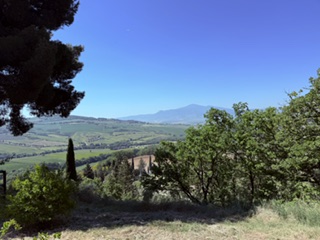
The rise to Tuscany was breathtaking, almost like an ibadah. The hills roll softly into horizon. Cypress trees stand like sentinels over Vineyards. Rosy the goat produces farm fresh milk, whereas George the donkey enjoys an aimless existence guarded by Woofers, a menacing dog that can take down 2-3 wolves at a time. Church bells echo through the stone street that have survived centuries. People sit for hours over wine, bread, olive oil and cheese, in solitude with no rush and the waiter acts as if she has forgotten you. You chew mindfully, savoring the local produce, grateful yet humble. Beauty is not treated as a luxury here, it is woven into ordinary life.
And it is at this moment that an uncomfortable question hit me. Why does this feel closer to paradise than many Muslim societies? The question sounds dangerous. Muslim clerics have created such a culture of prohibition that free thoughts like these seem blasphemous.
Taking a deeper dive, this is not about Christianity vs Islam, wine vs prohibition or about secularism versus religion. It reveals the difference between a civilization that aestheticizes life and one that has reduced religion to survival. Modern Muslims inherited a version of Islam that is dominated by rules, prohibition, outrage, identity politics, sectarianism, fear and suspicion of pleasures.
Historically, Islamic society was never emotionally barren. If you read the Quran, it’s description is lush and beautiful. Paradise is repeatedly described as aesthetically pleasing with gardens beneath which rivers flow, with shade, companionship, peace, fragrance and abundance. Islam did not emerge as rejection of beauty. It emerged to order beauty ethically. The tragedy in Islam today is that our rulers stopped building civilizations that reflected this vision. Classic Islamic civilization once understood something modern Muslims often forget humans cannot live on prohibition alone. It is true that humans need a meaning and the soul needs transcendence to reunite with the divine, but it also needs wonder, art, beauty, intellectual life, public dignity, harmony with nature, meaningful cities and refined culture.
This is why Cordoba, Isfahan, Ottoman Istanbul, Mughal Lahore and Samarkand mattered. They were not merely political powers. They were attempts to make earthly life resemble divine order. I remember the Shalimar garden in Lahore and the Blue Mosque in Istanbul. They were not just decorative. They symbolized paradise. Geometry was not merely mathematical; it reflected cosmic harmony. Calligraphy transformed language into sacred art. Architecture elevated daily existence to contemplation and even hospitality became a spiritual experience.
Somewhere along the way we got lost. Post colonial Muslim world compressed Islam into legality alone. A civilization that once produced philosophers, astronomers, physicians, architects and urban planners became consumed with external markers of piety. Keep the trousers above ankle, pray five times a day ostensibly, ritually fast and abstain from food while being away from spiritual piety and perform the pilgrimage almost like a Halal vacation with food and shopping extravagance.
As we ritualized Islam, our cities decayed aesthetically, intellectually and spiritually. I want to make it clear that this did not happen because Islam failed. It happened because Muslim civilizations lost confidence after centuries of collapse due to economic decline, colonial domination, authoritarian rule, institutional stagnation and defensive religious psychology. When you put a society under such pressure, they contract and such societies stop creating beauty. They become obsessed with preservation alone.
Today we are creating soulless cities in the middle east. The descent is palpable as you visit Dubai. Riyad is undergoing such a transformation as well. Our idea of modernity now seems to be aimlessly copying the worst part of western excess while turning away for the best part.
Tuscany showed me the meaning of renaissance more than any book would ever teach me. Italians have learnt how to sanctify earthly life without completely giving up on transcendence. They have discovered that beauty , pleasure, architecture, human love, art and even food can participate in the divine rather than distract from it. Before that, medieval Christianity often leaned heavily on ascetism, embracing suffering as holiness, suspicion of worldly pleasures and focus only on afterlife. Renaissance reintroduced the idea the world itself is meaningful, beauty matters, proportion matters, human flourishing matters and most importantly nature reflects God. That’s why Tuscany felt so metaphysical to me. The Vineyards, cypress roads, stone towns, olive groves, long lunches and slow evenings. These are no accidental rather a residue of centuries of people trying to harmonize order, beauty, labor, spirituality and community. Islam had versions of this too in Mughal gardens, Persian poetry, Ottomon courtyards and Sufi aesthetics. This is when Muslims were cultivating a culture and not hijacked by orthodoxy with a whip in its hand. Those who are affluent and have means live a great life vacationing in Europe, while the majority of those living in Muslim lands remain in search for a delayed paradise.
Tuscany is the result of centuries of cultural cultivation. That is why walking through it feel spiritually charged even for those with different cultures and traditions. Ironically, many of the values that make Tuscany feel transcendent are not foreign to Islam. They are deeply Islamic.”
- Proportion
- Contemplation
- Slowness
- Mindfullness
- Hospitality
- Cultivation of land
- Integration with nature
- Beauty with restrait
- Dignity in ordinary life
The crux of Islam is that we are Khalifa or guardians of earth. I ask the readers, does Dubai or Riyad feels led by Allah’s Khalifa or Tuscany and Florence.
The deeper crisis in much of modern Muslim world is not the lack of religiosity. We have plenty of it as I found out while being asked to pull up my trousers repeatedly while I was on Umrah in Mecca. It is the collapse of Ihsan. Ihsan means excellence, beauty refinement, spiritual depth. It is the dimension of Islam that transforms obedience into grace. Without Ihsan, religion becomes mechanical and law becomes exhausting. The future of Islam does not lie in louder preaching or stricter policing of morality. It will require Muslims to become mushsins and rebuild a civilization people want to inhabit. These Islamic civilizations will have beautiful cities, stable families, dignity in public life, appreciation of art, Modesty and Haya instead of pardah and chardewari, knowledge centers, protected nature, architectural masterpieces and life that is meaningful. In such societies, muslims will thrive and not seek escape.
My biggest lesson from Tuscany is that humans are not souls trapped temporarily in matter. We are embodied beings. Civilizations succeed when they realize that heaven is not only awaited, it is also symbolized. Let’s go out and make heaven on earth. Maybe that’s why Adam came here in the first place.
Prologue
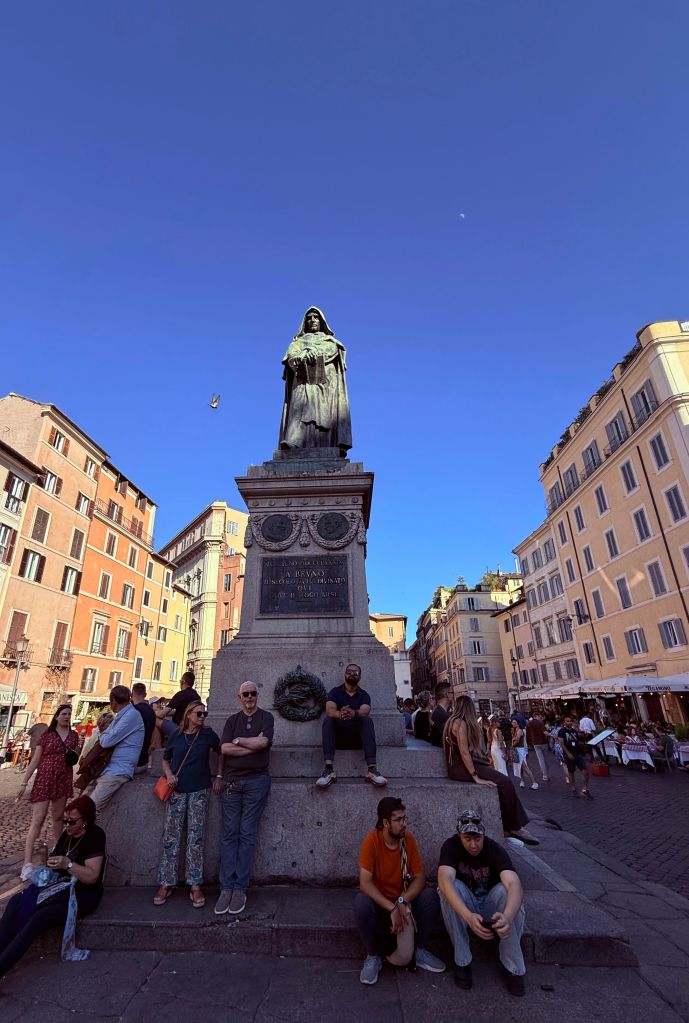
Nothing explains my state of mind better than the statue of Giordano Bruno. He was a philospher who delared in the fifteen hundreds that universe is infinite, the stars are distant suns and there might be other worlds. The church of course condemned him and burned him on the site of statue. The statue was erected in 1889 as a deliberate provocation to the Vatican by the Italian free thinkers as Bruno became the symbol of free thought, scientific inquiry and resistance to religous persecution.

 westernmassoutdoors